Density Demystified: The Science Behind Floating & Sinking Objects
Have you ever wondered why a massive ship can float effortlessly on water, yet a tiny stone sinks immediately? Or why oil always rises to the surface when mixed with water? The answer lies in density, a fundamental concept in Secondary 1 Science that explains how particles are packed in substances and why objects behave differently in liquids and gases!
Come along as we bring you through what Density is all about and how that relates to different real-life situations we often encounter!
Why Do Objects Float or Sink?
If you’ve ever thought about this question often, here’s the answer! Whether an object floats or sinks depends on its density relative to water:
- If an object is less dense than water, it floats.
- If an object is more dense than water, it sinks.
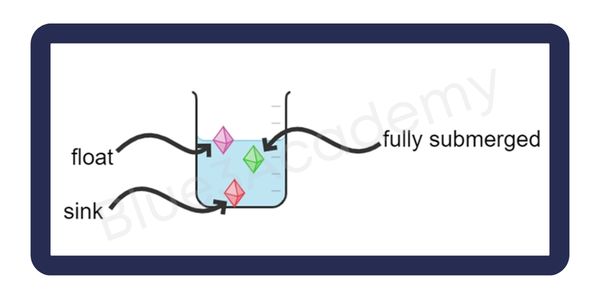
As simple an idea as it is, this principle is responsible for explanations behind why massive ships float, ice cubes stay on water, and small stones plunge to the bottom instantly!
What Is Density?
By definition, density is the measure of how tightly packed the particles in a substance are. It actually tells us why some objects float while others sink!
This is the formula for measuring density: Density = Mass ÷ Volume
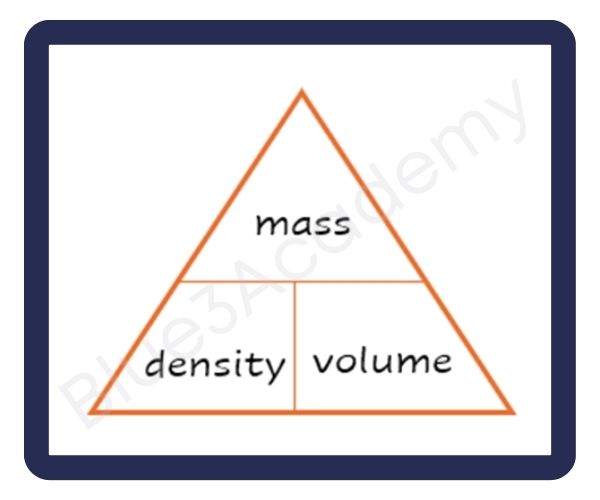
In short, the density of a substance is its mass per unit volume. Mass refers to how much matter an object contains, while Volume refers to how much space it occupies. This means that materials with tightly packed particles have a high density, while materials with more spaced-out particles have a low density.
When we display density values, the SI unit to be used is kg/m³, though g/cm³ is commonly used in school experiments. Here are the densities of some substances for reference!
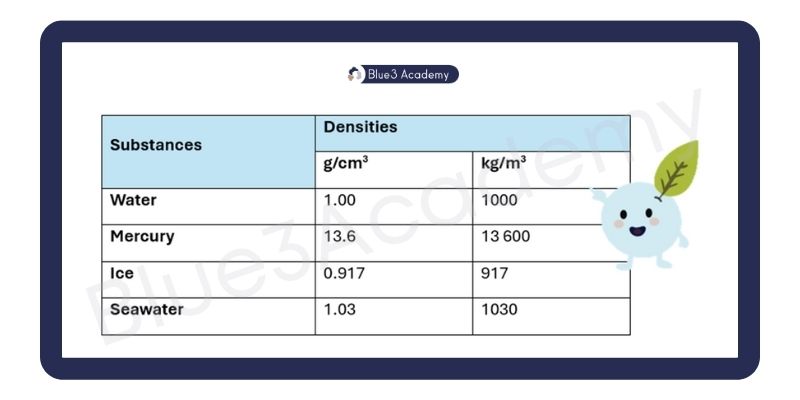
Ice has a lower density than water, which explains why ice floats on water!
Also, 1 cm3 of seawater has more mass than 1 cm3 of water because of the additional salt dissolved in seawater.
How Students Explore Density in School
Now that we’ve gone through the basics of density, you might be wondering how this concept is explored in Secondary 1 classes. In Lower Secondary Science classes, students observe density through practical experiments through these methods:
- Measuring Mass – Using an electronic balance to determine an object’s mass accurately.
- Measuring Volume –
- For regular shapes: length × width × height
- For irregular shapes: the use of a measuring cylinder and water displacement
- Calculating Density – Substituting the measured mass and volume into the density formula to derive your answer!
These hands-on activities help students visualise how particle arrangement determines whether objects float or sink, connecting textbook concepts to real-world observations!
Real-Life Applications of Density
Where else can we observe density in action? Here are a few more examples of how density can be used to explain everyday phenomena:
- Hot air rises because it’s less dense than cooler air.
- Ice floats on water, creating habitats for animals beneath frozen lakes.
- Helium balloons rise as helium is less dense than air.
- Oil in cooking floats on water, forming layers in soups or salad dressings.
Through these examples, students can see that density isn’t just a concept in a textbook — it governs the behaviour of objects in the world around us!
Turn Observation Into Understanding
The next time your child sees ice floating in water or oil forming a top layer in a salad dressing, there’s actually a fascinating science story behind it — and it all comes down to density. These everyday examples provide an opportunity for students to connect classroom learning with the world around them. By observing and analysing phenomena like floating and sinking, your child can start to see the principles of Secondary 1 Science in action and develop a deeper understanding of Lower Secondary Science concepts.
In our Secondary 1 Science Trial Classes, students don’t just read about density — they explore it hands-on. Activities are designed to help them experiment, ask questions, and link their observations to scientific reasoning. By turning curiosity into understanding, students gain confidence in tackling science questions and building problem-solving skills that go beyond memorising formulas!
Sign up for our Secondary 1 Science Trial Class today and let your child experience science the way it’s meant to be: interactive, engaging, and truly meaningful. From experiments with floating and sinking objects to other exciting Secondary 1 Science topics, your child will develop skills and insights that make Lower Secondary Science tangible, memorable, and fun.