
Diffusion Explained: Why Smells Spread Without You Noticing
Have you ever walked into a room and immediately noticed someone’s perfume, or opened a packet of chips only to have the smell fill the space? That’s diffusion in action — a fascinating natural process that affects everything from the food we eat to the oxygen we breathe.
If you’re a Primary 6 Student going into Secondary 1 this year, this will be one of the core topics you will be introduced to in Lower Secondary Science. Watch as we break down the topic of Diffusion for you with real-life examples within!
What Is Diffusion?
Diffusion is defined as the net movement of substances from a region of higher concentration to a region of lower concentration, down a concentration gradient, until a state of concentration equilibrium is achieved.
Understanding diffusion helps you see the science behind everyday experiences, from scents in a room to how nutrients reach your cells!
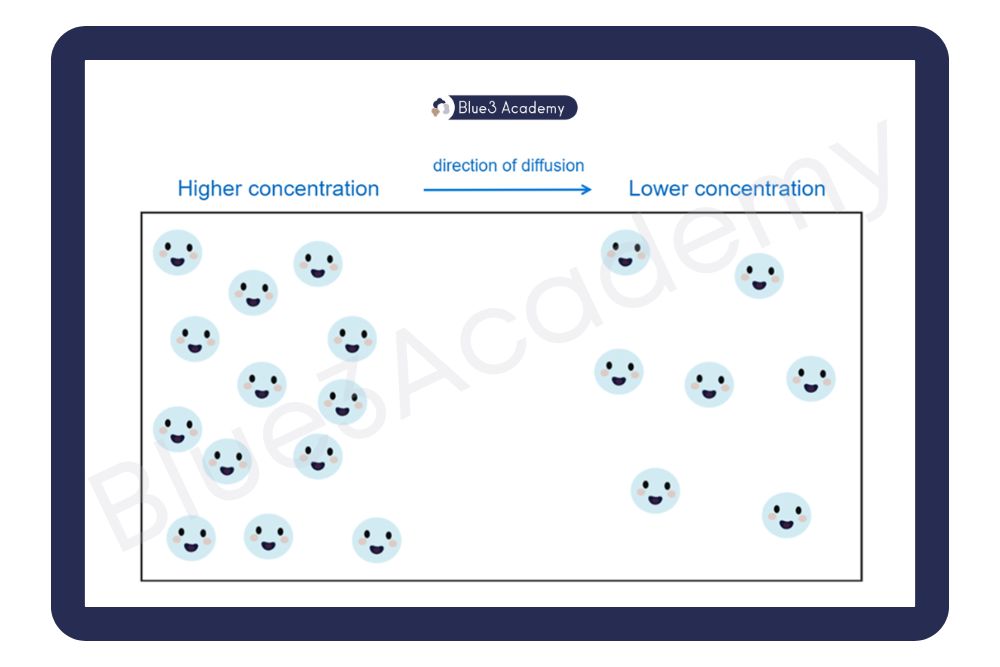
What Does Diffusion Happen?
Diffusion happens because particles in gases and liquids are constantly moving. They bump into one another, spread apart, and mix naturally, even without stirring or shaking. This movement continues until a concentration equilibrium is reached. Hence, it explains why smells, flavors, and even gases like oxygen move effortlessly in our environment.

Everyday Examples of Diffusion
So, how does this relate to everyday life? Here are examples you see almost everyday! You might not even realise that these are actually explained by the concept of diffusion.

Smells of food spreading in the air

Air freshener scent filling a room

Ink diffusing when dropped into water
Apart from our environment, this process also occurs inside the human body:
- Oxygen diffuses from the lungs into the bloodstream
- Nutrients diffuse into cells
How Diffusion Occurs Within Cells
Within our body, cells actually rely on diffusion to transport substances. These include glucose, oxygen, and carbon dioxide which diffuse across their membranes!

As depicted in the picture above, this is how substances navigate in and out of our cells! As such, nutrients are adequately distributed throughout our body for daily processes.
In the blood capillary, blood cells contain high concentration of oxygen and low concentration of carbon dioxide. Oxygen molecules then move from region of high concentration in blood cells into region of low concentration in the tissue cells through the capillary walls.
Likewise, carbon dioxide molecules diffuse from a region of high concentration in the tissue cells into the region of low concentration in blood cells as well.
How Diffusion Occurs Within Our Lungs
Did you know that this process also accounts for what happens in our lungs too? Gaseous exchange between alveoli (tiny air sacs in the lungs) and blood is a perfect example of diffusion in action:
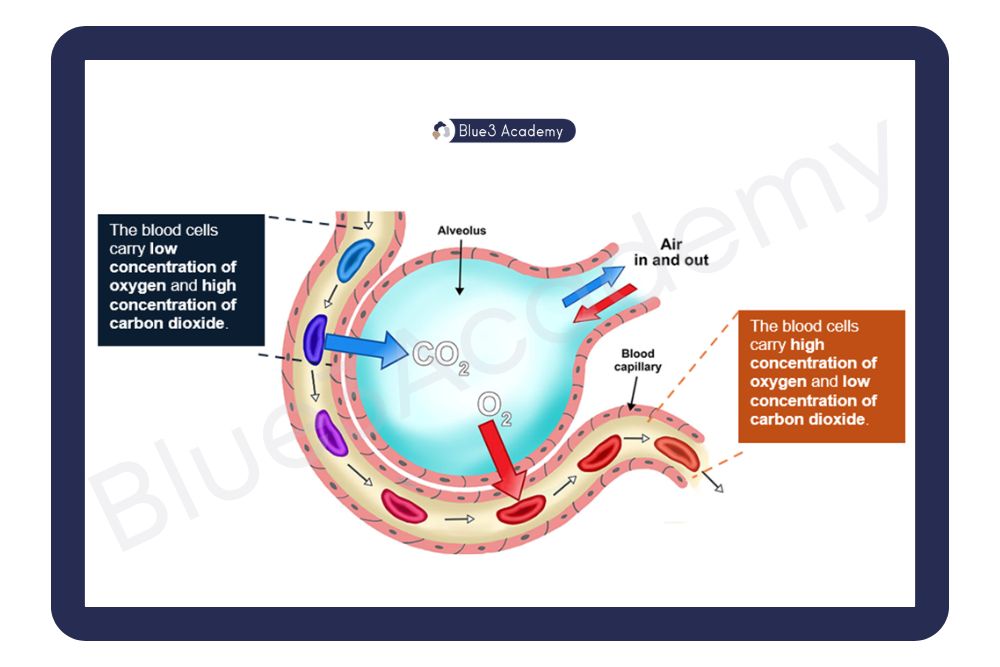
Movement of Oxygen molecules | Movement of Carbon Dioxide molecules |
● When we breathe in, the alveoli in the lungs contain a higher concentration of oxygen. ● The blood capillaries surrounding the alveoli contain a lower concentration of oxygen. ● Hence, the oxygen molecules diffuse from the alveoli into the blood capillary. | ● The blood capillaries that carry blood from other parts of the body to the lungs contain a higher concentration of carbon dioxide. ● Alveoli contain a lower concentration of carbon dioxide. ● Hence, the carbon dioxide molecules diffuse from the blood capillaries into the alveoli to be exhaled out. |
This shows that diffusion isn’t just a concept in textbooks — it’s a constant process happening inside our bodies every second. From the oxygen we inhale to carbon dioxide being removed from our cells, diffusion ensures that essential substances move efficiently where they’re needed.
By understanding this process, students can now better appreciate the connection between scientific principles and real-life functions that keep us healthy!
Why Concepts Like Diffusion Are Key in Science
Learning science is not just about memorising facts — it’s about seeing principles at work in the real world. Concepts such as diffusion show how substances move and interact. This helps students connect what they learn in the classroom to everyday phenomena, from how smells spread to how nutrients travel in the body.
Grasping these ideas early gives students a solid foundation for future topics in Sec 1 Science, including cells, gases, and chemical reactions.
Watch us Bring Science to Life — Try It Yourself
In our Science classes, students get hands-on experience with experiments that make abstract concepts tangible. Activities like observing diffusion in liquids or gases allow them to visualise scientific principles, analyse results, and understand the “why” behind what they see. With structured guidance, students can explore, ask questions, and build confidence in tackling science problems.
Sign up for our Secondary Science trial class today and experience how interactive experiments turn classroom science into a clear, engaging, and memorable learning experience!
👉🏻 Looking for more high-quality Math & Science content? Click here to access more free notes & resources!
📹 Do check out our Instagram & TikTok accounts for more academic videos!