
Master 5 Key Science Process Skills for Lower Secondary Science
Lower Secondary Science is getting more challenging — and memorising notes alone isn’t enough. Exams increasingly test reasoning, analysis, communication, and real application.
To excel, students must master Science Process Skills, which allow them to:
- Infer logical conclusions from clues
- Predict outcomes based on patterns
- Analyse data, graphs, and trends
- Evaluate methods and solutions effectively
- Communicate explanations clearly and logically
This guide breaks down each skill with real examples, step-by-step reasoning frameworks, and practical tips that both parents and students can use, helping learning become structured, effective, and exam-ready!
Science Process Skill #1: Inferring — Making Logical Conclusions From Clues
The first key skill that we will be covering is how to infer – Inferring is the ability to combine clues from the text or experiment with background knowledge to arrive at a logical conclusion.
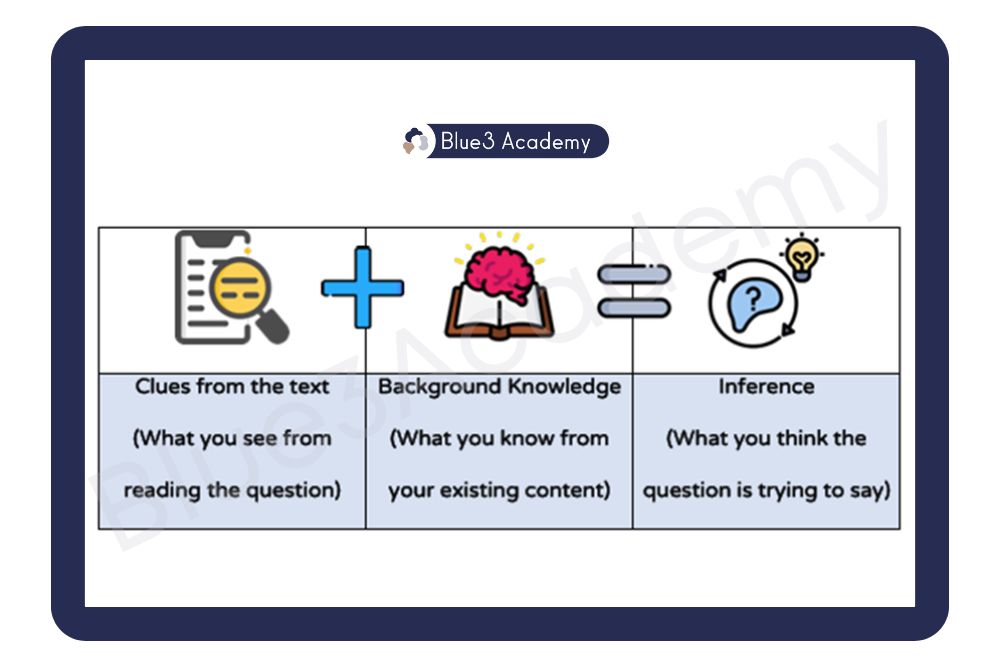
How to structure your answer
- Identify clues — What does the question or experiment show?
- Apply background knowledge — What concept does this relate to?
- Form your inference — What conclusion logically follows?
Example
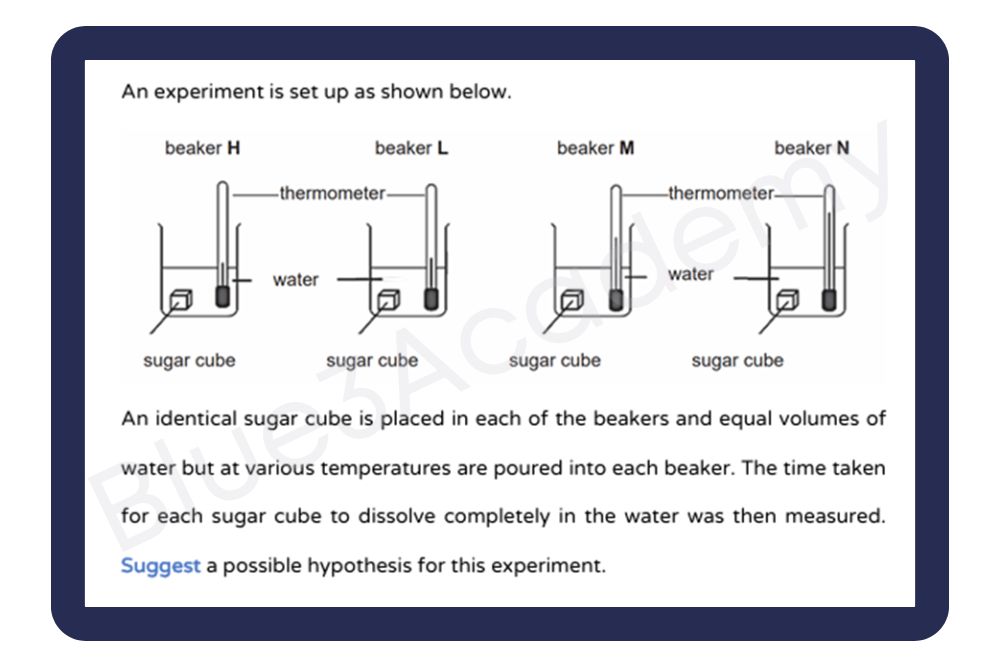
Clues from the text | Background Knowledge |
· Identical sugar cube · Equal volume of water · Water at various temperatures · Time taken for each sugar cube to dissolve completely in the water was measured | · Control variables: factors kept the same in the experiment · Independent variables: factors that you change in the experiment · Dependent variables: what you observe or measure in the experiment |
Inference | |
· Controlled variables: Mass of sugar cube; Volume of water; Type of sugar; Size of sugar cube · Independent variables: Temperature of the water · Dependent variable: Time taken for sugar cube to dissolve completely in water | |
Since the aim of the experiment is to find out how varying temperatures of water will affect the time taken for the sugar cube to dissolve completely in water, a possible hypothesis is: The higher the temperature, the faster the sugar cube dissolves.
Strong inferencing ensures students don’t lose marks for vague answers and helps them tackle unfamiliar questions with confidence.
Science Process Skill #2: Predicting — Using Patterns to Forecast Outcomes
Next, Predicting involves anticipating what will happen in a scientific scenario based on observed patterns or principles.
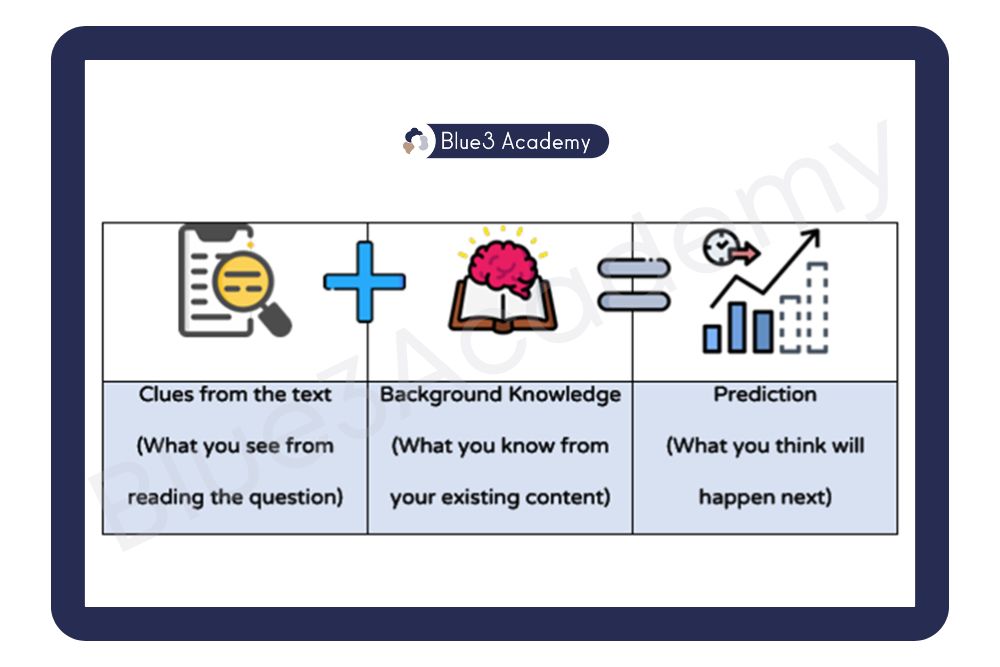
Steps to Make Accurate Predictions
- Identify the change or condition
- Recall the scientific principle
- Predict the logical outcome
Example
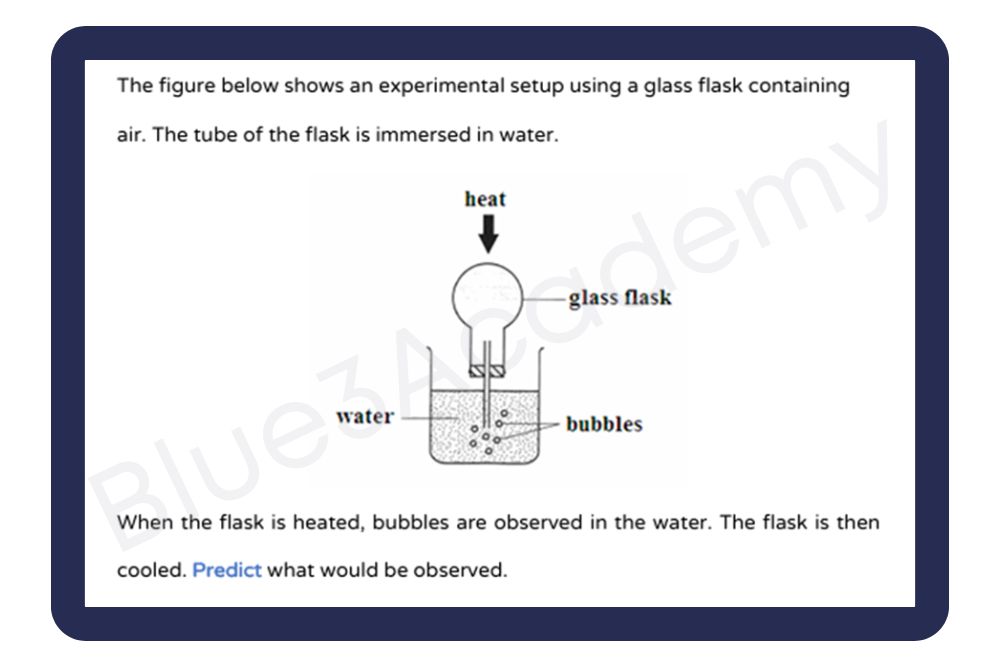
Clues from the text | Background Knowledge |
· Hot air is cooled | · Cold air contracts |
Prediction | |
· Cold air inside the glass flask occupies less space | |
By applying the prediction template as per above, a student may predict that:
“Water in the beaker is likely to flow into the flask / water level rises in the tube / water level in the beaker decreases.”
Prediction questions test understanding, not memorisation. Students must link cause → effect → principle to effectively tackle each question!
Science Process Skill #3: Analysing — Interpreting Data, Graphs, and Results
Moving on to our next skill, Analysing means going beyond describing what you see. It requires the student to identify trends, compare conditions, and explain why results occur.
How to Interpret Data Effectively
- Identify extremes (highest, lowest, largest change)
- Compare results across conditions
- Explain the trends using principles
Example
Clues from the text (What I see from reading the question) | Clues from the results (What I see from the looking at the data given in the question) |
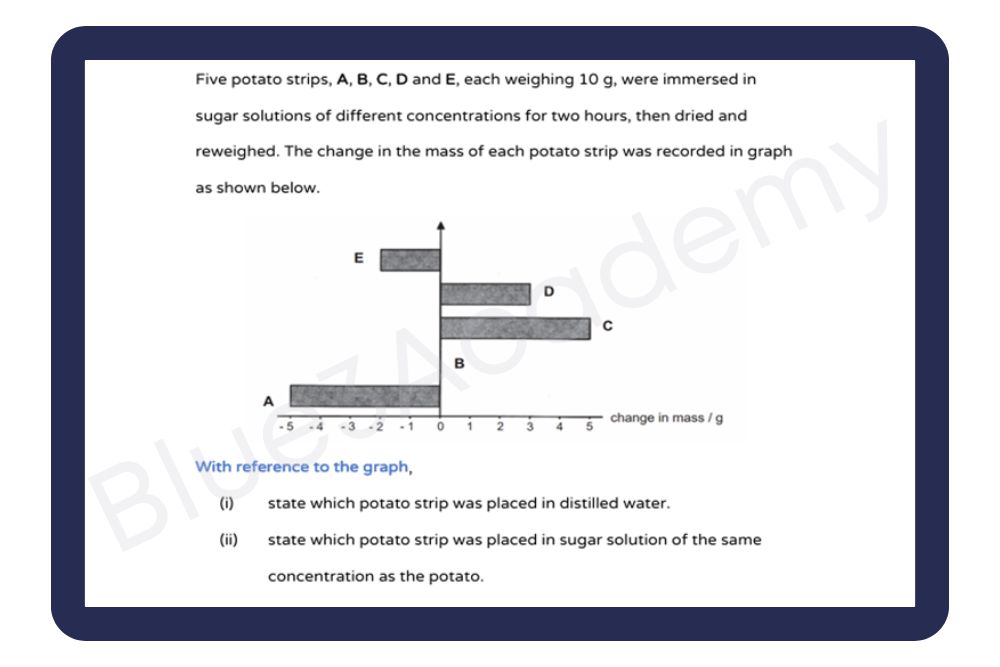
· Graph records the change in the mass of each potato strip after it has been immersed in sugar solutions of different concentrations for two hours | · The mass of A decreased by 5 g · The mass of B had no change · The mass of C increased by 5 g · The mass of D increased by 3 g · The mass of E decreased by 2 g |
By analysing the trends, it can be determined that:
- The strip that shrank the most was placed in sugar solution of highest concentration (least water potential) = Strip A
- The strip that gained the most was in distilled water (highest water potential) = Strip C
- The strip with no change was placed in sugar solution of same concentration as the potato = Strip B
Strong analysing skills help students make sense of data, explain trends clearly, and score higher in open-ended and experimental questions.
Science Process Skill #4: Evaluating — Choosing the Best Method With Reasoning
What does “Evaluating” actually mean? Specifically, it involves comparing methods and justifying which option best achieves the goal.

How to structure your answer
- Determine the goal: what outcome is expected
- Consider each method: how does it help achieve the goal?
- Predict advantages and limitations of each method
- Decide which is most effective and explain why
Example

Clues from the text | Background Knowledge |
Aim / Purpose Box to stop at Position T upon release (travel further distance) Methods · Lubricate ramp with oil · Use a box of a smaller mass · Raise the height of the ramp | Methods · Lubrication overcome friction · Smaller mass: ↓ GPE · Raising height of ramp means vertical distance from ground increases: ↑ GPE · Loss in GPE = Gain in KE |
Evaluate | |
· When friction is reduced, lesser energy is converted to thermal energy to overcome friction, so more GPE can be converted to KE, therefore the box moves faster and travels a further distance · When the box has smaller GPE, lesser energy is converted to KE, so the box moves slower and travels a smaller distance · When the box has higher GPE, more energy is converted to KE, so the box moves faster and travel a further distance | |
Hence, to increase the distance travelled by a metal box:
(A) Lubricating the ramp and (C) Raising the ramp height are effective because both reduce friction or increase gravitational potential energy.
Effective evaluation equips students to judge approaches critically and anticipate outcomes when tackling complex exam questions.
Science Process Skill #5: Communicating — Writing Clear, Step-by-Step Explanations
Lastly, with all the other skills in mind – Communicating means expressing ideas in an organised, scientific, and accurate way.
How to structure your answer
- State steps or ideas in order
- Highlight key observations or critical steps
- Use accurate scientific terms
- End with a clear conclusion
Example
Thought | Write |
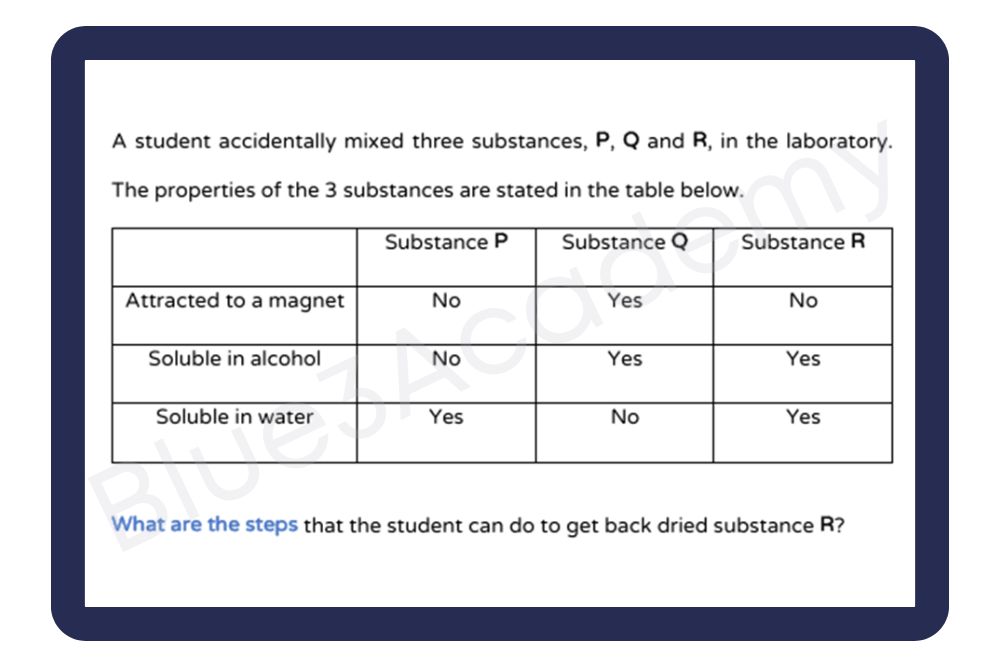
· Substances present: P, Q, R · I want to separate Q (magnetic) from P (non-magnetic) and R (non-magnetic) | · Use a magnet to remove substance Q |
· Substance present: Q, R · I want to separate P (soluble in alcohol) from R (insoluble in alcohol) | · Add alcohol to remove substance P |
· Substance present: R · I want to obtain dried R (soluble in water) | · Evaporate the alcohol to obtain dried substance R |
Hence, the steps are:
- Use a magnet to remove substance Q from the mixture.
- Add alcohol to the remaining mixture and stir to dissolve substance R.
- Pour the mixture through a filtration set-up. Substance P will be trapped on the filter paper as residue while substance R will flow through as filtrate.
- Evaporate the alcohol to get back dried substance R.
Students often know what to do but lose marks due to unclear answers. Now with structured communication, this ensures full credit for experimental and open-ended questions!
Why These 5 Science Process Skills Matter More Than Memorising Content
Always remember – Memorising definitions or procedures helps only partially!
With these key Science Process skills, students can now:
- Tackle unfamiliar scenarios with confidence
- Explain answers logically
- Score higher in open-ended and experimental questions
- Build a foundation for upper secondary Chemistry, Physics, and Biology
This is what separates top scorers from average students!
Together, let’s help your child build confidence by mastering these 5 Essential Science Process Skills through structured guidance:
✔ Apply concepts in hands-on practice
✔ Break down tricky scenarios step by step
✔ Use frameworks to answer open-ended questions
✔ Strengthen experimental understanding
✔ Become exam-ready with proven strategies
Try a Trial Class and see how effective, structured learning makes Lower Secondary Science easier — and more enjoyable!
👉🏻 Enjoying our content so far? Click here to view more useful free notes & resources!