
Lower Secondary Science: 5 Science Techniques to Tackle Questions
Lower Secondary Science often feels manageable at first—until students realise that exam questions are more about applying what they know. Many parents notice the same pattern: their child studies hard but still can’t score consistently. That’s because Lower Secondary Science tests technique just as much as content.
In this guide, you’ll learn 5 proven Science answering techniques that help students tackle structured questions with accuracy and confidence. By the end, you’ll know exactly how to support your child in building strong Science foundations for Sec 1 and Sec 2.
Science Technique 1 – Constructing Scientific Explanations
Moving to Secondary Science, many students struggle to link concepts to the information provided. By learning how to construct clear explanations, students can connect their knowledge directly to the question and answer confidently.
How to tackle questions accurately:
- Identify the topic of the question.
- Recognise the associated scientific concepts.
- Observe the information given in the question.
- Link concepts with question details.
Example
Magnesium fluoride and hydrogen fluoride have very different boiling points. Explain the difference using your knowledge of their bonding.
Now, we can put these steps into practice!
- Identify the topic: Determine the main focus of the question, e.g., Chemical Bonding.
- Recognise associated scientific concepts: Recall relevant concepts such as ionic bonding and covalent bonding.
- Observe information given: Note key details in the question, e.g., magnesium fluoride and hydrogen fluoride.
- Link concepts with question details: Connect the concepts to the observations. For example, MgF₂ is ionic while HF is covalent, so MgF₂ has stronger bonds that require more energy to break, resulting in a higher boiling point.
Hence, a strong response begins by clearly stating the difference in boiling points: MgF₂ has a higher boiling point than HF. MgF₂ is an ionic compound with a giant lattice structure, so more energy is required to overcome the strong electrostatic forces between the positively- and negatively-charged ions. In contrast, HF is a simple covalent compound where the molecules are held together by weaker van der Waals forces.
By linking the type of bonding to the observed boiling points, students provide a complete, logical explanation that references the information given in the question.
Key Tip: A common mistake when constructing answers is relying solely on prior knowledge without referencing the information provided, so do make sure to link your explanation directly to the question details!
Science Technique 2 – Unit Conversion
Unit conversion is a common stumbling block in Lower Secondary Science questions, especially when students rush through calculations without fully understanding the units. Many parents notice that their child can memorise formulas but still make mistakes in exams because they skip steps or misapply prefixes. Mastering unit conversion helps students handle a wide range of questions confidently, from density calculations to energy problems.
How to tackle questions accurately:
- Know the base units and derived units.
- Understand unit prefixes, such as kilo-, centi-, and milli-.
- Identify the information given in the question and the units required.
- Apply the correct conversions step by step.
Example
Convert 5 g/cm³ into kg/m³.
Now, we can put these steps into practice!
- Know the base and derived units: Identify the units involved, e.g., grams (g) and metre (m); derived unit of m³ for volume.
- Understand unit prefixes: Recall relevant prefixes such as centi (c = 10⁻²) and kilo (k = 10³).
- Observe the information given: Note the value and unit provided in the question, e.g., 5 g/cm³.
- Apply the conversion step by step: Convert 5 g/cm³ to kg/m³ by applying the base units and prefixes: 5 g/cm³ = 5000 kg/m³.
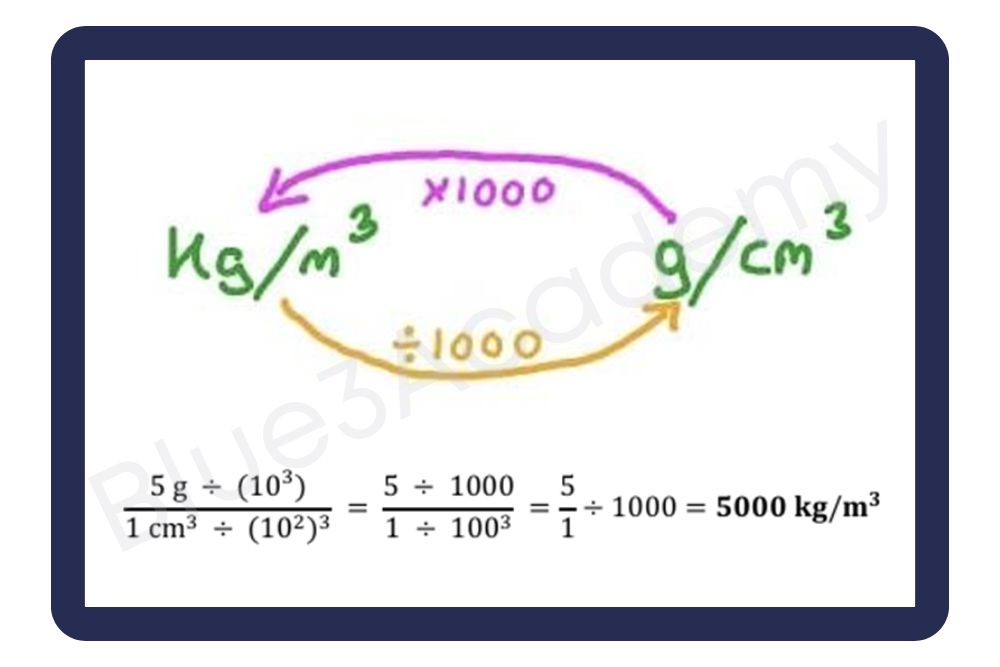
This approach ensures students tackle unit conversion questions systematically, reducing errors and making their answers clear and accurate.
Key Tip: Write out your intermediate steps clearly to avoid mistakes, as skipping steps can lead to errors and loss of marks.
Science Technique 3 – Graph Plotting
Graphs are a common feature in Lower Secondary Science questions! Accurately plotting graphs is essential for scoring well as teachers often assess not just the results but also how students present data. Incorrect scales, missing labels, or poorly plotted points can cost marks even when the calculations are correct. Mastering graph plotting allows students to visualise trends, interpret experiments, and demonstrate a clear understanding of the relationships between variables. This technique equips students to handle experimental and data-based questions more effectively!
How to tackle questions accurately:
- Identify the X-axis (independent variable) and include the correct units.
- Identify the Y-axis (dependent variable) and include the correct units.
- Label the axes clearly and choose an appropriate scale.
- Plot points accurately and draw a best-fit line if required.
Example
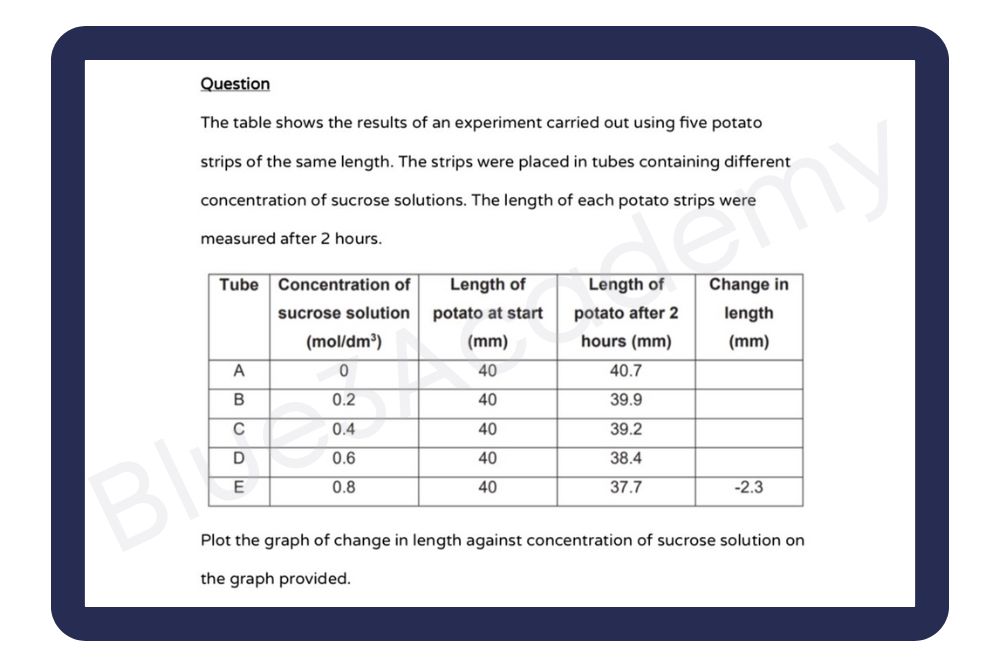
Now, we can put these steps into practice!
- Determine the X-axis: Identify the variable you are changing — concentration of sucrose solutions (mol/dm³).
- Determine the Y-axis: Identify the variable you are measuring — change in the length of potato strip (mm).
- Label and scale the axes correctly: Make sure each axis has the correct units and an appropriate scale.
- Plot points accurately: Ensure the points are placed correctly according to the data.
- Draw the best-fit line: Check that there is an equal number of points on each side of the line and that the distances between the line and points are roughly equal.
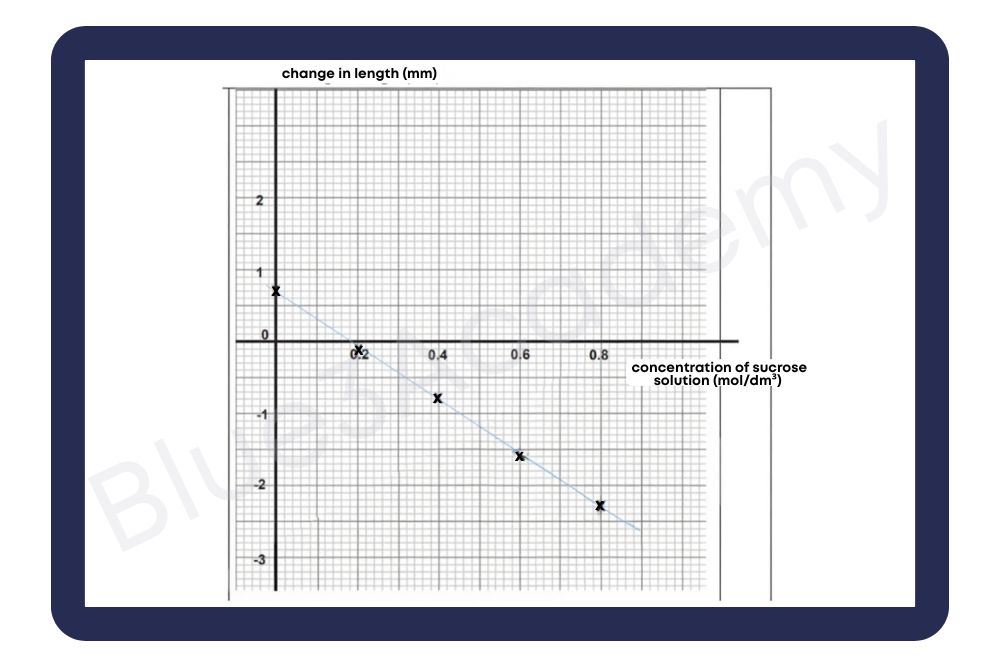
Key Tip: Double-check that your axes are labelled correctly and that your points are accurately plotted before drawing a best-fit line!
Science Technique 4 – Applying Scientific Knowledge
Application questions in Lower Secondary Science test how well students can use scientific concepts to explain real-world scenarios. Simply memorising definitions isn’t enough; students must observe the context of the question and select the appropriate principle to justify their answers. Mastering this technique helps students reason through experiments, explain everyday phenomena like heat transfer, and demonstrate a clear understanding of scientific relationships.
How to tackle questions accurately:
- Identify the topic of the question.
- Observe the information provided carefully.
- Identify the associated scientific concepts that are relevant.
Example

Now, we can put these steps into practice!
- Identify the topic: The question focuses on the features of the gloves → Topic: Physical Properties.
- Observe the information given: The mention of “oven” indicates high temperature (heat).
- Identify associated scientific concepts: Recall the concept of Thermal Conductivity — how easily heat passes through materials.
- Apply the concept: The gloves are meant to protect hands from heat, so the material must be a poor conductor. Cotton is likely the material because it can reduce heat transfer.
As such, a strong response begins by clearly saying that cotton is a porous fabric that is filled with air while air is a poor conductor of heat / good insulator. Therefore, wearing cotton kitchen gloves when taking food out of the oven can prevents user from getting burned.
Key Tip: Connect your answer to the context provided in the question instead of relying solely on memorised facts. This ensures your explanation is complete and exam-ready!
Science Technique 5 – Applying Formulas
Many formula-based questions in Lower Secondary Science present scenarios that mirror real-world situations, such as calculating energy usage, speed, or chemical quantities. Understanding what each value represents in context before performing calculations helps students apply formulas accurately and avoid common mistakes, ensuring their answers reflect both the numbers and the scenario correctly.
How to tackle questions accurately:
- Identify the topic of the question.
- Observe the information given carefully.
- Identify the correct equation to use.
- Substitute the relevant values step by step.
Example
An oven with a power rating of 1400 W was used for 150 minutes to thaw a Christmas turkey. Given that 1 unit of energy costs $0.30, calculate the cost of energy used.
Now, we can put these steps into practice!
- Identify the topic: The question involves power, energy, and time → Topic: Electrical Systems.
- Observe the information given: Note the power rating (1400 W), time (150 minutes), and cost per unit ($0.30).
- Identify the equation: Total Cost = Power (kWh) × Cost per unit.
- Substitute values step by step: Convert the power to kW and time to hours:
Total Cost = (1400 ÷ 1000) × (150 ÷ 60) × 0.30 = $1.05.
Following this step-by-step approach allows students to handle formula-based questions methodically and produce clear, accurate calculations.
Key Tip: Check your units before substituting values into the formula, as incorrect conversions are a frequent source of errors in Science exams!
Why Mastering Lower Secondary Science Techniques Matters for Tackling Questions
Mastering these Lower Secondary Science techniques helps students tackle a wide variety of questions with confidence. By applying science question‑solving techniques across formula calculations, graph plotting, unit conversions, constructing explanations, and application questions, students can systematically approach every problem. These strategies make it easier to interpret data, link observations to scientific concepts, and solve both structured and open-ended questions accurately, ensuring they are prepared for any exam scenario.
Practise, Apply, and See the Difference — Trial with us
Structured guidance allows students to practise each technique effectively and build real-world problem-solving skills. With step-by-step methods, students learn how to:
✔ Apply formulas, convert units, and plot graphs accurately
✔ Construct clear scientific explanations linked to question context
✔ Analyse experiments and interpret results logically
✔ Handle Lower Secondary Science question strategies with confidence
Sign up for a Trial Class and experience how structured learning in Lower Secondary Science transforms question-solving into a systematic, manageable, and practical process that strengthens understanding and exam readiness.
👉🏻 Enjoying our content so far? Click here to view more useful free notes & resources!
📚 View Part 1 of our Lower Secondary Science Series here on Science Process Skills that every Sec 1 & 2 MUST know!